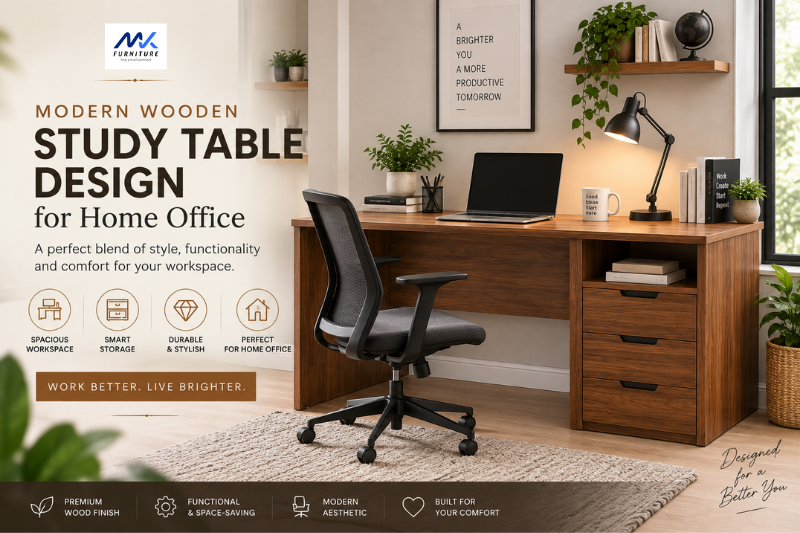
Modern Wooden Study Table Design for Home Office
In today’s flexible work environment, a thoughtfully designed workspace can make everyday work more comfortable, organized, and productive. A Modern Wooden Study Table Design for Home Office can become the central element of such a workspace by combining practical storage, durable construction, comfortable proportions, and an attractive appearance. People looking for furniture inspiration can also explore Instagram, while mkfurniture provides ideas for contemporary wooden furniture and workspace solutions. For homeowners, professionals, students, and business owners working from home, selecting the right Modern Wooden Study Table Design for Home Office is not simply about finding a surface for placing a laptop. It influences organization, posture, concentration, and the overall character of a room. A well-planned wooden desk can also make a compact room feel functional without making it visually crowded.
Why a Well-Designed Home Office Table Matters
Working from home often means adapting an existing bedroom, living room, spare room, or corner into a dedicated workspace. The challenge is to create an area that supports concentration while fitting naturally into the interior.
A desk provides the foundation for that arrangement. It needs enough space for everyday equipment such as a laptop or desktop computer, monitor, keyboard, mouse, notebook, documents, chargers, and stationery. At the same time, it should not occupy unnecessary floor space.
The best approach is to consider the workstation as part of the entire room rather than an isolated furniture item. Its dimensions, storage, finish, color, construction, and position should harmonize with the surrounding interior.
Wood is particularly useful because it provides a warm visual quality while allowing designers and furniture manufacturers to create a wide range of forms. From simple floating desks to large executive-style workstations, wooden furniture adapts effortlessly to diverse requirements.
Choosing the Right Table Size for a Home Office
The correct dimensions depend on the room, work style, equipment, and number of users.
Someone who works primarily on a laptop may need a relatively compact surface. A person using two monitors, a desktop computer, speakers, notebooks, files, and other accessories will require substantially more workspace.
Before selecting a desk, measure the available wall and floor area. Consider not only the width of the table but also the space required for an ergonomic chair and clear movement around the workstation.
A useful planning method divides the available space into three primary zones:
- Working zone: The surface where primary tasks happen.
- Storage zone: Drawers, shelves, cabinets, or overhead storage.
- Movement zone: The clearance required to sit, stand, and move comfortably.
This framework prevents a common mistake: purchasing a large desk that looks impressive but makes the room difficult to navigate. For compact setups, a straight desk positioned against a wall is often efficient. For larger rooms, an L-shaped configuration creates dedicated areas for computing, writing, and administrative tasks.
The Advantages of Wooden Furniture in a Workspace
Wooden furniture has remained popular because it pairs tactile warmth with design versatility. Depending on the grain and finish, wood complements modern, minimalist, industrial, Scandinavian, traditional, or luxury interiors.
One major advantage is structural flexibility. A wooden workstation can be manufactured with open shelving, flush drawers, concealed cabinets, cable-management grommets, adjustable storage, or integrated lighting.
Another benefit is visual balance. A room filled with screens, cables, power adapters, and peripherals can feel sterile. Wood introduces a natural element that softens the tech-heavy atmosphere.
Different finishes also shape the room’s character: light wood shades make a compact workspace feel airy and bright, while rich, darker finishes establish a formal, executive presence.
Modern Minimalist Study Table Concepts
Minimalism works especially well in home offices because unnecessary visual clutter creates cognitive distraction.
A minimalist desk focuses on clean architectural lines, restrained detailing, practical proportions, and hidden utility. Rather than adding elaborate banks of cabinetry, the design relies on one or two carefully integrated compartments.
A wall-hung desk is a prime example. Fixed directly to the wall without conventional legs, it leaves the floor clear underneath, making compact rooms feel visibly larger. Another approach is a slim rectangular desk with an integrated pencil drawer that keeps essential tools out of sight while preserving an open top.
Storage Ideas for Better Organization
Without adequate storage, documents, cables, headphones, notebooks, and hardware quickly spread across the worktop, reducing usable space.
Drawers work best for small daily tools, closed cabinets secure bulky hardware and archives, and open shelves display books, plants, and reference manuals. Combining closed and open storage provides the most practical balance:
- One shallow stationery drawer for pens and accessories
- A deeper drawer for files and notebooks
- A side cabinet or CPU compartment
- Open overhead shelves for easy access
- Dedicated cable-management trays and power bays
The exact arrangement should follow your daily workflow rather than decorative symmetry alone.
Cable Management for a Modern Workspace
A modern workstation typically hosts a laptop, external monitor, mechanical keyboard, mouse, audio monitors, charging docks, and power bricks.
Without built-in cable management, wiring becomes an immediate eyesore. A practical table incorporates flush grommet openings, an under-desk wire channel, or a recessed rear chase to conceal power strips and excess cable lengths.
Planning wire paths before manufacturing or purchasing furniture is critical, as drilling through finished panels or retrofitting cable trays after installation is often inconvenient.
Choosing the Right Wooden Finish
The finish dictates how the desk interacts with ambient light and surrounding decor.
Light oak and ash finishes complement pale walls and Scandinavian aesthetics. Rich walnut and teak tones bring warmth and executive gravitas. Matte protective coatings are widely favored in contemporary setups because they eliminate specular glare from overhead task lights and minimize visible fingerprints.
Coordinate the desk finish with existing architectural woodwork—such as door frames, flooring, or built-in wardrobes—to maintain visual harmony across the room.
Ergonomics and Comfortable Working
Ergonomics should lead the design process. Tabletop height, surface depth, chair adjustments, and monitor clearance must align to prevent strain during long workdays.
The work surface should allow forearms to rest parallel to the floor with shoulders relaxed, while the primary monitor sits at eye level roughly an arm’s length away. Generous, unobstructed legroom beneath the tabletop is essential—drawers and support braces must not encroach on knee clearance.
Designing for Small Spaces, Corners, and Floating Layouts
- Compact straight desks: Deliver maximum utility along a single wall plane without protruding into high-traffic paths.
- Corner and L-shaped units: Transform underutilized room perimeters into dual-zone workstations that separate screen work from analog writing or paperwork.
- Floating study desks: Wall-mounted configurations open up floor space, providing a sleek, modern silhouette ideal for studio apartments and guest rooms.
Key Workstation Configurations Compared
| Configuration | Best For | Footprint | Storage Capacity | Cable Management Ease |
| Slim Straight Desk | Compact bedrooms, laptop workflows | Minimal (3–4 ft width) | Light (1 shallow drawer) | High (direct drop down wall) |
| Floating Wall Desk | Studio apartments, minimalist rooms | Zero floor footprint | Light to Moderate | Very High (concealed in wall/chase) |
| L-Shaped Corner Table | Multi-monitor setups, mixed workflows | Moderate to Large | High (side pedestals, open shelves) | High (ample rear frame space) |
| Built-In Wall-to-Wall | Dedicated home offices, executive use | Full wall span | Maximum (overhead & base cabinets) | Exceptional (fully integrated channels) |
Dedicated Setups: From Dual Monitors to Video Calls
- Dual-monitor engineering: Requires at least 28 to 30 inches of surface depth to accommodate monitor stands or clamp-on arms while leaving sufficient space for keyboard, wrist rest, and writing pads.
- Video-call staging: The space behind the desk serves as your digital business card. An integrated wooden bookcase or clean acoustic slatted wall panel creates an organized, professional background for virtual meetings without visual clutter.
- User-tailored features: Designers and freelancers benefit from wider surface areas and tablet storage; students require integrated book ledgers; business owners need lockable filing drawers for confidential records.
Practical Implementation: Modern Wooden Study Table Design for Home Office
Investing in a Modern Wooden Study Table Design for Home Office requires balancing material integrity with structural functionality. Reviewing key specifications before manufacturing or purchasing ensures the furniture performs reliably under daily commercial or personal use:
- Tabletop Depth: A minimum depth of 24 inches for laptop setups, increasing to 28–32 inches for desktop monitors and multi-screen rigs.
- Standard Ergonomic Height: 29 to 30 inches from floor to desktop surface, paired with an adjustable task chair.
- Surface Durability: High-pressure veneer, solid hardwood, or edge-banded commercial ply finished with matte polyurethane to resist heat, scratches, and spills.
- Structural Hardware: Full-extension soft-close ball-bearing drawer slides and concealed heavy-duty hinges.
- Integrated Power: Dedicated desktop brush grommets, under-desk wire trays, and rear-panel clearance for uninterrupted power strip access.
Custom Built vs. Ready-Made Solutions
While modular off-the-shelf tables offer speed, commissioning a custom Modern Wooden Study Table Design for Home Office allows you to tailor dimensions around architectural quirks like alcoves, low windows, structural pillars, and wall-outlet locations. Custom fabrication also lets you select specific wood tones and internal drawer configurations matching your exact toolset. For those planning custom interior woodwork, mkfurniture serves as a helpful reference point for contemporary styling and layout planning.
Maintenance and Workspace Longevity
Preserving natural wood surfaces requires simple, consistent maintenance:
- Dust daily using a clean, dry microfiber cloth.
- Wipe accidental spills immediately to protect the grain and protective topcoat from moisture rings.
- Avoid aggressive solvent-based sprays or abrasive scrubbers; clean with mild, wood-safe diluted soaps when necessary.
- Shield the tabletop from prolonged exposure to direct midday sunlight to prevent uneven fading.
- Periodically check drawer slide alignment and tighten mounting fasteners on monitor arms or leg brackets.
Frequently Asked Questions
What should I look for in a Modern Wooden Study Table Design for Home Office?
Focus on tabletop depth, ergonomic working height, durable joinery, adequate knee clearance, integrated wire management, and storage configured around your daily tools.
What dimensions work best for a compact home office?
For small rooms, a straight or floating desk measuring 36 to 42 inches wide and 20 to 24 inches deep provides sufficient space for a laptop and notebook without crowding the room.
How does a Modern Wooden Study Table Design for Home Office handle cable clutter?
High-quality designs integrate desktop grommets, under-table wire raceways, and concealed power bays to keep extension strips, adaptors, and peripheral cords organized and hidden.
Can a Modern Wooden Study Table Design for Home Office support multiple monitors?
Yes. For multiple displays, choose a sturdy desk with a minimum depth of 28 to 30 inches, solid structural support, and desktop reinforcement suitable for clamp-style monitor arms.
Is an L-shaped or straight desk better for productivity?
Straight desks are ideal for single-screen workflows and smaller rooms. An L-shaped desk works best for professionals who need dedicated zones to separate screen work from physical paperwork.
A well-executed Modern Wooden Study Table Design for Home Office bridges the gap between commercial functionality and residential comfort. By tailoring surface proportions, integrating smart cable channels, and selecting durable wooden materials, you create an organized work environment that supports sustained daily focus.