Designer Wooden Console Table for Living Room: Stylish Ideas for Modern Homes
A well-designed living room is often defined by the furniture that combines beauty, function, and proportion. A Designer Wooden Console Table for Living Room can become an important part of that balance by adding a refined surface for decoration while making unused wall or sofa areas more useful. Today, homeowners can explore furniture inspiration on Instagram, compare contemporary interiors, and discover practical designs through brands such as mkfurniture. For people looking for quality wooden furniture, mkfunriture focuses on designs that can complement different home interiors while offering practical functionality. You can explore more furniture ideas through mkfurniture.
What Is a Wooden Console Table?
A wooden console table is a relatively narrow furniture piece designed to provide a useful surface without occupying excessive floor space. It can be positioned against a wall, behind a sofa, near an entrance, beneath artwork, or beside another furniture arrangement.
Unlike a large cabinet or bulky storage unit, a console table generally has a slimmer profile. This makes it suitable for living rooms where homeowners want additional functionality without making the space feel crowded.
Modern console tables are available in many designs. Some feature clean straight lines, while others use curved edges, decorative panels, drawers, open shelving, or combinations of wood and other materials.
The purpose of the table can also vary according to the room. It may hold decorative objects, books, lamps, plants, photographs, keys, or everyday accessories. Designs with drawers and cabinets can provide additional concealed storage.
Why Wooden Console Furniture Works Well in Living Rooms
Wood remains one of the most versatile materials for home furniture. Its natural visual character can work with traditional, contemporary, minimalist, industrial, and transitional interiors.
A wooden console table can add warmth to a living room dominated by glass, metal, stone, or neutral surfaces. At the same time, a carefully selected finish can help the table blend with existing furniture.
The biggest advantage is flexibility. A console table does not necessarily need to perform only one function. It can be decorative furniture, practical storage, a display surface, or a transition piece between different areas of the home.
Wooden furniture also offers many choices in finish. Depending on the design, homeowners can select natural-looking textures, matte surfaces, darker tones, lighter finishes, or contemporary decorative treatments.
Choosing the Right Size
Size is one of the most important considerations when selecting a console table. A beautiful design can still look unsuitable if its dimensions are not appropriate for the room.
Before purchasing furniture, measure the intended area. Consider the available width, depth, and height. Also check the distance between the console and nearby furniture so that people can move comfortably around the room.
For a narrow wall, a compact console may be sufficient. A wider wall can accommodate a larger design that creates a stronger visual presence.
Height should also be considered in relation to nearby furniture. When placed behind a sofa, the table should generally relate visually to the sofa height. When positioned against a wall, its height should work with the artwork, mirror, lighting, or decorative objects above it.
Console Tables for Small Living Rooms
Small living rooms require careful furniture selection. Large furniture pieces can quickly make the space feel crowded, so slim and functional designs are often useful.
A compact console can provide a decorative surface without requiring the floor area of a larger cabinet. Wall placement can make an unused section of the room more productive.
Storage can also be valuable in a small home. A console with drawers or closed compartments can help keep small items organized while maintaining a clean appearance.
Open shelving can work when homeowners want frequently used objects to remain accessible. Closed storage is useful when the goal is to hide clutter.
For compact apartments, a simple wooden design with a narrow depth can create functionality without visually overwhelming the room.
Minimalist Wooden Console Designs
Minimalism focuses on simplicity, proportion, and purposeful design. A minimalist console table may use straight lines, a restrained finish, limited decoration, and clean hardware.
This type of furniture can work particularly well in contemporary homes. Instead of relying on elaborate ornamentation, the design allows the material, proportions, and surrounding décor to create visual interest.
A minimalist console can be paired with a small lamp, a framed photograph, a decorative vase, or a carefully selected art piece. Keeping the surface uncluttered helps preserve the clean appearance.
Minimalist furniture is also useful for homeowners who prefer interiors that feel calm and organized.
Using a Console Table Behind the Sofa
The area behind a sofa is frequently left unused. A narrow console table can transform this space into a functional design zone.
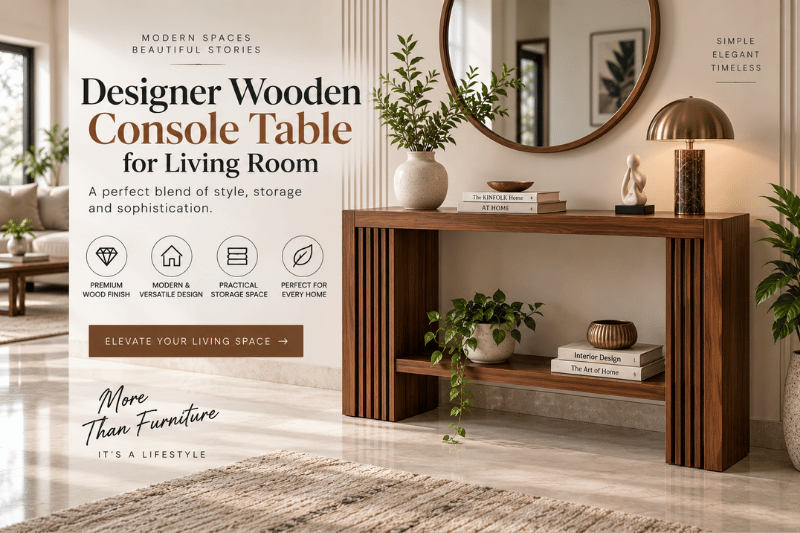
A Designer Wooden Console Table for Living Room placed behind a sofa can provide a surface for lamps, plants, books, photographs, and decorative accessories.
When choosing this arrangement, movement around the sofa should remain comfortable. The table should not make the walking path unnecessarily narrow.
A behind-sofa console can also visually separate a seating area from another part of an open-plan home. This makes the furniture useful not only as storage or decoration but also as part of the overall room layout.
Wall-Mounted Console Tables
Wall-mounted furniture is another option for modern interiors. A floating console can create a lightweight appearance because the floor underneath remains visible.
This style can be particularly useful in smaller rooms. The visible floor area can contribute to an open visual effect.
Wall-mounted designs can include drawers, shelves, or a simple tabletop. Their appearance can range from extremely minimal to highly decorative.
Proper installation is important because the wall must be capable of supporting the furniture and the objects placed on it. The mounting method should be appropriate for the wall construction and furniture weight.
Console Tables With Drawers
Drawers add practical storage to an otherwise decorative furniture piece.
A console with one or more drawers can be useful for storing remote controls, stationery, chargers, keys, documents, small electronics, and other everyday items.
The number and size of drawers should depend on the intended use. Too many drawers may make a small console look visually heavy, while too few may not provide sufficient functionality.
Hardware also influences appearance. Minimal handles can create a contemporary look, while decorative handles can introduce a more traditional character.
Soft-closing mechanisms and good-quality drawer runners can further improve everyday usability.
Console Tables With Cabinets
Cabinet storage offers another way to keep belongings organized. Closed compartments can hide items and maintain a cleaner appearance.
A cabinet-based console may work well in living rooms where homeowners need additional storage but do not want a large standalone cupboard.
Interior shelves can be adjusted according to the design. Some users may need space for books or larger objects, while others may primarily store smaller accessories.
Cabinet doors can also become part of the visual design. Plain panels offer a minimalist appearance, whereas fluted, grooved, framed, or textured fronts can create more visual interest.
Open-Shelf Console Designs
Open shelves provide easy access and allow decorative objects to become part of the furniture arrangement.
Books, plants, baskets, sculptures, photographs, and small décor pieces can be displayed on these shelves.
However, open storage requires organization. If too many objects are placed on every shelf, the furniture can look cluttered.
A balanced arrangement usually works better. Leave some empty space between objects and vary the height and shape of decorative pieces.
For homes where dust management is a concern, closed storage may be more practical.
Fluted and Textured Wood Designs
Textured furniture has become a popular direction in contemporary interiors. Fluted and grooved surfaces can create depth without requiring elaborate ornamentation.
A fluted console can become a feature piece against a plain wall. Vertical lines can also contribute to a sense of height.
Texturing can be applied to drawer fronts, cabinet doors, side panels, or the entire front surface.
The surrounding décor should be considered carefully. When the furniture already has a strong texture, simpler accessories can help maintain visual balance.
Curved and Rounded Console Tables
Straight lines are not the only option for modern furniture. Rounded corners and curved forms can introduce a softer character.
A rounded console may be suitable for interiors where homeowners want to reduce the sharp visual appearance of rectangular furniture.
Curved designs can work especially well near circulation areas because rounded corners may feel visually softer than sharp edges.
The design should still maintain practical proportions. Decorative curves should not unnecessarily reduce usable storage or surface space.
Mixing Wood With Other Materials
Wood can be combined with several materials to create contemporary furniture designs.
Glass can create a lighter appearance. Metal can introduce an industrial or modern character. Stone-look surfaces can add a premium visual effect.
The combination should be intentional. A console with too many competing materials can lose visual consistency.
For example, a wooden body with subtle metal hardware can create a clean contemporary look, while wood and glass may produce a more open appearance.
Choosing the Right Finish
Finish plays a major role in the final appearance of wooden furniture.
Lighter finishes can help a room feel bright and airy. Medium wood tones can create warmth, while darker finishes can introduce a more dramatic and sophisticated appearance.
The choice should consider the existing floor, sofa, wall color, doors, cabinets, and other furniture.
Matching every furniture piece exactly is not always necessary. In many modern interiors, complementary finishes can create more depth.
A console can therefore either coordinate with existing furniture or deliberately act as a contrasting accent.
Using a Console as a Display Area
One of the simplest uses for console furniture is creating a dedicated display surface.
A mirror above the table can make the arrangement feel more complete. Artwork can provide a focal point, while plants introduce natural texture.
Lighting is another useful addition. A table lamp can provide decorative value as well as soft evening illumination.
Homeowners should avoid covering the entire tabletop. Leaving visible surface area helps the furniture itself remain part of the composition.
Styling With Plants
Plants can make wooden furniture feel more natural and welcoming.
Small indoor plants can be placed on the tabletop, while taller plants may work beside the console.
The size of the plant should relate to the furniture. Very large plants can overwhelm a compact console, while very small plants may disappear visually on a large table.
Planters can also be selected to coordinate with the room’s existing materials.
For people who prefer low-maintenance décor, artificial plants or dried arrangements can provide a similar visual effect.
Adding Mirrors and Artwork
A console table often becomes more visually effective when paired with something on the wall above it.
A large mirror can create a focal point and reflect light. Artwork can introduce color and personality. A collection of smaller frames can create a gallery-style arrangement.
The width of the wall décor should relate to the console. An extremely small artwork above a large console may look disconnected, while an oversized piece can dominate the entire arrangement.
Spacing also matters. The artwork should feel connected to the furniture without appearing directly attached to it.
Creating a Balanced Furniture Arrangement
Interior design is largely about proportion and balance. A console should not appear isolated from the rest of the room.
Consider nearby furniture such as sofas, chairs, coffee tables, rugs, lamps, and cabinets.
If the room already contains several large furniture pieces, a simpler console may provide balance. If the rest of the room is minimal, a more distinctive console can act as a feature.
Decorative accessories should also be distributed thoughtfully rather than concentrated in one area.
Custom Furniture Options
Every home has different dimensions and storage requirements. For this reason, customized furniture can be useful when standard sizes do not fit.
A custom console can be designed according to available wall width, desired height, storage requirements, material preferences, and interior style.
Customization may include drawer arrangements, cabinet sizes, shelf placement, finishes, handles, textures, and overall dimensions.
Working with an experienced furniture maker can also help homeowners understand which design elements are practical for everyday use.
For customers exploring customized wooden furniture, mkfunriture can be considered as part of the furniture selection process.
Selecting Furniture for Indian Homes
Indian homes can vary significantly in layout and style. Apartments, independent houses, compact urban homes, and larger residences may all require different furniture solutions.
A console table can work in many of these environments because of its relatively narrow profile.
In a traditional interior, a warmer wood finish and decorative detailing may complement the existing décor. In a contemporary apartment, a clean-lined design with minimal hardware may be more appropriate.
The key is to select furniture according to the room rather than following a design trend without considering practical requirements.
Console Tables Near the Entrance
Although commonly associated with living rooms, console tables can also be placed near an entrance.
An entryway console can provide a convenient surface for keys, wallets, decorative objects, or small storage baskets.
A mirror above the table can make the entrance arrangement more functional. Drawers can provide hidden storage for frequently used items.
If the entryway is narrow, a slim design is particularly important so that the furniture does not interfere with movement.
Budget Considerations
Furniture budgets can vary considerably depending on material, construction, dimensions, finish, storage features, hardware, and customization.
A simple console with a basic design may cost less than a large customized piece with multiple drawers and cabinets.
Instead of considering only the initial price, homeowners should consider construction quality and intended usage.
A frequently used piece of furniture may justify investment in stronger construction and better hardware.
The goal should be to find an appropriate balance between appearance, functionality, durability, and budget.
Common Mistakes to Avoid
One common mistake is selecting furniture without measuring the available area.
Another is choosing a design based only on appearance without considering storage requirements.
Overloading the tabletop with accessories can also make the room look untidy.
Ignoring the existing furniture style may result in a console that feels disconnected from the rest of the interior.
Homeowners should also consider maintenance requirements before selecting a particular finish or texture.
Maintenance of Wooden Console Furniture
Regular maintenance can help wooden furniture retain its appearance.
Dust should be removed using an appropriate soft cloth. Spills should be cleaned promptly rather than being allowed to remain on the surface.
Harsh cleaning products should be avoided unless the furniture manufacturer specifically recommends them.
Furniture should also be protected from prolonged exposure to excessive moisture or direct sunlight when the finish is sensitive to these conditions.
Drawer runners, hinges, and handles can be checked periodically to ensure that they continue to operate smoothly.
How to Make a Console Table a Focal Point
A console becomes a focal point when its design and placement attract attention without making the room feel unbalanced.
One approach is to select distinctive texture or detailing. Another is to use lighting and wall décor to create a complete arrangement.
A simple wooden console can become visually interesting through carefully selected accessories.
The most effective arrangement is usually one where the furniture, wall décor, lighting, and surrounding furniture work together rather than competing for attention.
Designer Wooden Console Table for Living Room: Modern Trends, Storage and Buying Guide
A stylish living room should balance visual appeal with everyday functionality. A Designer Wooden Console Table for Living Room can help achieve this balance by providing a practical surface, useful storage, and a distinctive furniture element without requiring the floor space of a large cabinet. Modern homeowners can find inspiration through Instagram, explore furniture collections from mkfurniture, and choose designs that suit their room dimensions, décor preferences, and lifestyle. mkfunriture focuses on furniture solutions designed to combine practical use with contemporary aesthetics.
Modern Console Table Trends for Contemporary Homes
Contemporary furniture trends increasingly focus on simplicity, functionality, and clean visual lines. Instead of highly complicated furniture shapes, many homeowners prefer designs that provide useful features while maintaining a refined appearance.
Modern console tables can include straight silhouettes, rounded edges, textured fronts, open shelving, drawers, cabinets, or mixed materials. The choice depends on the room and the intended purpose of the furniture.
A simple console can work as a decorative surface, while a storage-focused model can help organize everyday household items.
The most useful trend is multifunctionality. Furniture is increasingly expected to perform more than one role, especially in apartments and compact homes.
Luxury Wooden Console Furniture
Luxury furniture does not always require excessive decoration. A premium appearance can come from carefully considered proportions, high-quality finishes, refined detailing, and well-integrated storage.
A luxury wooden console can feature textured panels, concealed handles, elegant hardware, carefully finished surfaces, or distinctive geometric details.
The surrounding room should remain part of the design decision. If the living room already contains several decorative elements, a simpler console may provide better balance.
In a more minimal interior, a detailed console can become the main feature.
Accessories can further enhance the arrangement. A sculptural lamp, decorative vase, artwork, mirror, or carefully selected books can complement the furniture.
Compact Furniture for Apartment Living
Apartments often require furniture that makes efficient use of available space.
A slim console can occupy an unused wall while providing additional surface space. A wall-mounted design can create an even lighter visual effect because more floor area remains visible.
For smaller living rooms, depth is particularly important. A console that extends too far into the room can interfere with circulation.
Storage requirements should also be considered. A compact design with a few drawers may be more useful than a larger decorative piece with no storage.
Furniture selection should always begin with measurements. Once the available space is understood, homeowners can select a suitable design.
Storage-Focused Console Designs
Storage can transform a console from a purely decorative furniture item into a practical part of the living room.
Different storage options serve different purposes.
Drawers are useful for smaller objects such as remote controls, chargers, stationery, keys, and documents.
Cabinets can hide larger items and maintain a clean visual appearance.
Open shelves are suitable for books, plants, baskets, photographs, and decorative objects.
A combination of these features can provide both concealed and visible storage.
The ideal configuration depends on how the furniture will be used. A family may require more closed storage, while someone who primarily wants a display surface may prefer open shelving.
Planning Drawer Storage
When selecting furniture with drawers, think about the items that will be stored inside them.
Small drawers can help separate everyday accessories and prevent them from becoming mixed together.
Larger drawers can accommodate books, documents, electronic accessories, or other household objects.
Drawer depth and internal height should be suitable for the intended contents.
Quality drawer runners can also improve the user experience. Smooth operation makes the furniture easier to use regularly.
The number of drawers should be proportional to the size of the console. Excessive drawer sections can make a narrow furniture piece look visually heavy.
Cabinet Storage and Organization
Cabinet compartments provide concealed storage and can help maintain a neat living room.
Before choosing a cabinet-style console, consider the size of the objects that need to be stored.
Adjustable shelves provide flexibility when storage requirements change. Fixed shelves may offer structural stability but have less flexibility.
The exterior of the cabinet also contributes to the overall appearance.
Plain cabinet doors can create a minimalist look, while fluted, grooved, framed, or textured fronts can make the furniture more decorative.
Handleless doors can provide a clean contemporary appearance, while visible handles can become an intentional design feature.
Open-Shelf Console Furniture
Open shelves can make a console appear visually lighter and provide convenient access to decorative and functional objects.
Books, plants, baskets, photographs, artwork, and small sculptures can all be displayed.
However, open storage requires careful organization.
One useful approach is to create small groups rather than filling every shelf. Leave some empty space between objects to maintain visual balance.
Different heights can also create a more interesting arrangement.
If the room is already visually busy, fewer decorative objects may produce a better result.
Console as a Room Divider
Open-plan homes often require subtle ways to define different functional areas.
A console can help separate a living room from another area without creating a permanent wall.
For this application, furniture that looks attractive from both sides can be especially useful.
Open shelving can allow light and visibility to pass through, while cabinets provide additional storage.
A console room divider can therefore perform two functions: visually defining the room and providing practical furniture space.
This approach can be useful in apartments, studio homes, and large open living areas.
Integrating a Console With a TV Setup
A console can also be incorporated into a television or entertainment arrangement.
When used below a wall-mounted TV, it can provide space for media accessories, remote controls, décor, and selected electronic equipment.
Cable management should be considered during the design stage.
Cable openings or concealed channels can help maintain a clean appearance.
If electronics are stored inside cabinets, sufficient ventilation should be considered where required.
The console should also be proportionate to the television and surrounding wall. A very small console beneath a large television may look unbalanced, while an oversized unit can dominate the room.
Combining Wood With Other Materials
Modern furniture frequently combines different materials to create contrast.
Wood paired with glass can create a lighter visual appearance.
Wood combined with metal can introduce an industrial or contemporary character.
Wood with stone-look surfaces can create a premium aesthetic.
The key is moderation. Too many materials can make the design feel visually complicated.
A wooden body with subtle metal hardware, for example, can create a simple contemporary appearance without overwhelming the furniture.
Fluted and Textured Designs
Textured furniture can add depth to a living room without relying on bright colors.
Fluted and grooved surfaces are particularly effective when used on drawer fronts, cabinet doors, or feature panels.
Vertical textures can introduce visual rhythm and make a piece feel more architectural.
Because textured furniture already attracts attention, accessories should generally be kept relatively simple.
A plain wall, neutral décor, and carefully selected lighting can allow the furniture texture to remain the main feature.
Rounded and Curved Furniture
Curved furniture forms can soften a room that contains many straight lines.
Rounded corners may also be useful in areas where people move frequently around the furniture.
A curved console can create a different visual character from traditional rectangular designs.
However, the shape should not reduce functionality unnecessarily.
Storage compartments, drawers, and usable surface area should still meet the homeowner’s requirements.
Curved furniture can work particularly well in contemporary and transitional interiors.
Hardware and Small Details
Hardware can have a significant influence on the final appearance of wooden furniture.
Slim handles can support a modern look, while decorative handles may complement traditional interiors.
Handleless designs can create a seamless appearance.
The hardware finish can also be coordinated with other metal elements in the room, including lighting fixtures, door handles, decorative objects, and furniture legs.
Small details such as edge finishing, drawer alignment, door gaps, and surface quality can also influence the perception of furniture craftsmanship.
Customizing the Furniture
Standard furniture sizes do not work equally well in every home.
A customized console can be designed according to the available wall width, preferred height, storage needs, finish, and interior style.
Customization can include:
- Overall dimensions
- Drawer quantity
- Cabinet layout
- Shelf arrangement
- Surface finish
- Hardware
- Panel texture
- Leg design
- Handle style
- Cable-management openings
This approach can be especially useful when the room has unusual dimensions.
Choosing a Suitable Furniture Maker
The furniture maker plays an important role in the final result.
Before ordering customized furniture, homeowners should discuss dimensions, materials, construction, finish, storage requirements, hardware, delivery, and installation.
Clear specifications help reduce misunderstandings.
It is also useful to confirm the final design before manufacturing begins.
For people researching wooden furniture options, mkfunriture can be included among the furniture brands they explore, while mkfurniture provides an online destination for discovering furniture-related options.
Budget and Value
Furniture prices can vary depending on dimensions, materials, construction quality, finish, storage, hardware, and customization.
A simple console will generally involve fewer components than a large customized model with several drawers and cabinets.
Instead of focusing only on the initial price, consider the expected frequency of use and the required durability.
A frequently used piece may justify better hardware and stronger construction.
A decorative console that is rarely used may have different priorities.
The right choice should balance appearance, functionality, construction, maintenance, and budget.
Choosing a Finish
The furniture finish should relate to the existing room.
Light finishes can support bright interiors and may work well in compact spaces.
Medium wood tones can add warmth.
Dark finishes can create contrast and a more dramatic appearance.
The finish does not have to match every wooden item in the room exactly.
Complementary finishes can create more visual depth while maintaining a coordinated interior.
Texture should also be considered. A heavily textured finish may be more visually prominent than a smooth surface.
Styling the Console
Once the furniture is installed, styling can determine how successfully it integrates into the room.
A simple styling arrangement can include a mirror or artwork above the table, a lamp on one side, and a plant or decorative object on the other.
Books can introduce height and texture.
A decorative tray can group smaller objects together.
The objective is to create a visual hierarchy rather than filling every available space.
Empty space is also part of good furniture styling.
Mirrors Above Console Furniture
A mirror can make a console arrangement feel more complete.
It can reflect light and visually extend the room.
The mirror size should be proportionate to the furniture beneath it.
A large mirror can create a strong focal point, while a smaller decorative mirror can produce a more subtle effect.
The frame can also connect the mirror to the console through color or material.
Artwork and Decorative Objects
Artwork is another effective way to personalize the furniture arrangement.
One large artwork can create a clear focal point.
Several smaller frames can create a gallery-style arrangement.
Decorative objects should be selected according to the room’s existing colors and textures.
Plants, ceramics, books, lamps, sculptures, and photographs can all contribute to the arrangement.
Avoid placing too many unrelated objects together because this can reduce the visual impact of individual pieces.
Lighting Ideas
Lighting can highlight the console and its surrounding wall.
A table lamp provides both decorative and practical value.
Wall lighting can draw attention to artwork or textured furniture.
Indirect lighting can create a softer evening atmosphere.
If the console is used near an entrance or circulation area, lighting can also improve visibility.
The scale of the light should match the furniture. A very large lamp may overwhelm a compact console.
Furniture for Indian Interior Styles
Indian homes include a wide variety of interior styles.
Some homeowners prefer traditional wooden furniture with warmer finishes and decorative detailing.
Others prefer contemporary designs with straight lines, minimal hardware, and neutral surfaces.
A modern Indian living room can also combine traditional materials with contemporary furniture forms.
A console table is flexible enough to work with these different approaches.
The most important consideration is how the furniture relates to the rest of the room.
Making Furniture Suitable for Family Life
Living rooms are frequently used by multiple members of a household.
Furniture should therefore support everyday activities.
Families may benefit from closed storage for controlling clutter.
Rounded corners can be considered in homes where children frequently move around the room.
Easy-to-clean finishes can be useful for busy households.
If pets share the home, furniture placement and surface durability may also influence the choice.
The best design is one that works with real daily habits rather than only looking attractive in photographs.
Long-Term Furniture Selection
Furniture should ideally remain useful as the home changes.
A versatile console can be moved or restyled when the room is redesigned.
Neutral finishes can work with changing wall colors and accessories.
Functional storage can remain valuable even when decorative preferences change.
This makes timeless proportions and practical construction important considerations when buying furniture.
Sustainability and Responsible Furniture Use
Long-term use is one practical consideration when choosing furniture.
A well-maintained furniture piece can continue serving its purpose for many years.
Repairable hardware, replaceable components, adaptable styling, and durable construction can support longer use.
Homeowners can also consider whether a furniture piece could serve another purpose if the current room layout changes.
For example, a console originally used in the living room may later work in an entrance area, hallway, bedroom, or home office.
Maintenance Tips
Regular maintenance can preserve the furniture’s appearance.
Dust surfaces using a soft, suitable cloth.
Clean spills promptly.
Avoid excessive moisture.
Use cleaning products that are appropriate for the furniture finish.
Do not drag heavy decorative objects across the surface.
Check drawer runners, handles, and hinges periodically.
Avoid exposing finishes to conditions that may cause damage, such as excessive moisture or prolonged direct sunlight, unless the finish is specifically designed for those conditions.
Simple regular maintenance is usually easier than repairing neglected furniture.
Common Buying Mistakes
Several mistakes can be avoided with basic planning.
The first is failing to measure the room.
The second is choosing a design without considering how the furniture will actually be used.
Another common mistake is purchasing too much storage when only a decorative surface is required.
The opposite can also happen when homeowners choose a beautiful open design but later discover that they need concealed storage.
Color and finish should also be considered in relation to the existing interior.
Finally, homeowners should not ignore construction quality simply because the furniture looks attractive.
Buying Checklist
Before finalizing your furniture selection, check:
- Available wall or floor space
- Furniture width
- Furniture depth
- Furniture height
- Walking clearance
- Storage requirements
- Drawer configuration
- Cabinet arrangement
- Shelf requirements
- Material and finish
- Hardware quality
- Interior style
- Maintenance requirements
- Customization options
- Delivery requirements
- Installation requirements
This checklist can simplify the decision-making process.
Frequently Asked Questions
What is a console table used for?
A console table provides a narrow surface for display, organization, lighting, decoration, or storage. It can be positioned against a wall, behind a sofa, near an entrance, or in another suitable location.
Is a wooden console suitable for a modern home?
Yes. Modern wooden furniture can use clean lines, contemporary finishes, textured panels, minimalist hardware, and mixed materials to complement contemporary interiors.
What size console should I choose?
The appropriate size depends on the available space and intended use. Measure the area first and make sure sufficient walking clearance remains around the furniture.
Can a console provide storage?
Yes. Depending on the design, it can include drawers, cabinets, shelves, or a combination of storage features.
Can I customize a wooden console?
Customization can include dimensions, storage layout, finish, hardware, texture, shelves, drawers, and other design details.
Can a console be placed behind a sofa?
Yes. A narrow console can work behind a sofa if there is enough space for comfortable movement and the table height is suitable.
What accessories work well on a console?
Common choices include lamps, mirrors, artwork, books, plants, vases, photographs, trays, and decorative objects.
How can I keep the console from looking cluttered?
Use fewer accessories, vary their heights, group related objects together, and leave some visible empty space.
Are floating consoles suitable for small rooms?
Floating designs can create a lighter visual effect by keeping the floor underneath visible. Proper wall installation is essential.
How do I maintain wooden furniture?
Dust regularly, clean spills promptly, avoid excessive moisture, use suitable cleaning products, and periodically check hardware and fittings.
Final Thoughts
A console table can make a meaningful difference to the appearance and functionality of a living room without requiring the footprint of a large cabinet.
A Designer Wooden Console Table for Living Room can provide a useful combination of display space, storage, craftsmanship, and visual character.
The most suitable design depends on the room’s dimensions, existing furniture, storage requirements, preferred materials, finish, and personal style.
Modern homeowners can choose from minimalist designs, textured fronts, rounded forms, open shelves, drawers, cabinets, mixed materials, and customized configurations.
For compact apartments, slim furniture can help use space efficiently. For larger homes, a more substantial design can create a focal point or help divide an open-plan layout.
The selection process should begin with practical requirements. Measure the available area, decide how the furniture will be used, determine the required storage, and then select a design that complements the room.
With thoughtful planning, wooden console furniture can remain useful and visually relevant for many years.
For homeowners exploring furniture options, mkfurniture can be used as an online destination for wooden furniture ideas, while mkfunriture can help represent the company and furniture-focused brand identity throughout the content.
A successful furniture choice is ultimately one that combines proportion, functionality, material quality, design, and everyday usability.