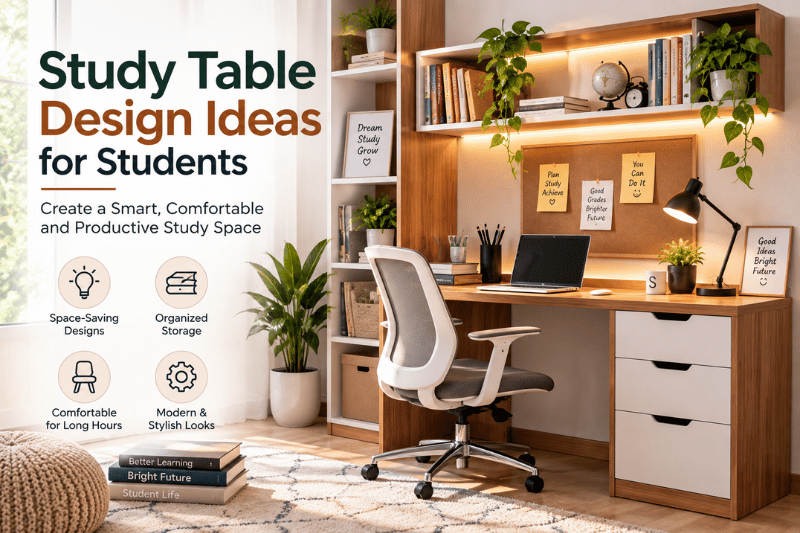
Study Table Design Ideas for Students: The Complete Guide
Finding the right study table design ideas for students is one of the most practical decisions a family can make, because the desk is where homework, revision, online classes and late-night exam preparation actually happen. At mkfurniture, we speak with parents and students every day about desks that are too high, too small or too cluttered to work at, and we share real room setups and desk inspiration on Instagram as well. This guide brings that experience together in two parts. Part 1 explains why design matters, the correct measurements and twelve popular desk styles. Part 2 covers materials, storage, lighting, layouts, budgets, care and a final buying checklist.
Quick answer: what makes a good study table for a student?
A good study table matches the student’s height, offers at least 100 cm of width and 55 cm of depth, keeps books and stationery within arm’s reach, sits near natural light and stays steady when a student writes on it. The best desk is not the most expensive or the most decorative one. It is the desk a student can sit at comfortably for one to three hours without back pain, eye strain or clutter building up around them.
Look for these seven qualities before you buy:
- A height that suits the student’s age and the chair being used
- Enough surface for a notebook, a laptop and a reference book at the same time
- Storage that keeps daily items close but out of sight
- A solid, wobble-free structure
- Rounded edges and a matte, non-glare finish
- Access to good lighting and a nearby power socket
- A look the student genuinely likes, so the desk actually gets used
Why the design of a study table matters
Many families treat the study table as an afterthought. A desk is picked because it fits a gap in the room, matches the bed or was on offer. Yet students spend an enormous part of their day at it. A school student may sit at a desk for homework and revision for two to four hours every day, and a board exam or competitive exam aspirant may sit for six hours or more. Over months and years, a badly designed desk quietly affects posture, eyesight, concentration and even mood.
Posture is the most visible issue. When a desk is too high, the shoulders creep upward and the neck tightens. When it is too low, the student slouches forward and the lower back rounds. Neither position is sustainable during long study sessions. Eyesight is the second issue. A desk placed in a dim corner, or one with a glossy surface that reflects a lamp, forces the eyes to work harder than they should. Concentration is the third. A surface buried under loose papers, chargers and old notebooks makes it harder to begin work, and beginning is often the hardest part of studying.
Design also shapes habits. A desk with a clear place for every item helps a student build a routine: sit down, open the bag, arrange the books, start. A desk with no storage teaches the opposite habit, where everything ends up on the bed, the floor or the dining table. Emotional connection matters too. Students who help choose the colour, the finish or the layout of their desk usually feel more ownership of their study space, and that ownership turns into more consistent use.
This is why comparing study table design ideas for students is worth real time and thought. The goal is not to copy a picture from social media. It is to match a design to the student’s age, subject load, room size and daily routine. The sections below show how to do exactly that, starting with the measurements that matter most.
Ergonomics first: the right measurements for a student desk
Ergonomics simply means fitting the furniture to the person rather than forcing the person to adapt to the furniture. For a student desk, four measurements do most of the work: height, width, depth and legroom.
Desk height
The correct desk height lets the student sit with feet flat on the floor or on a footrest, knees bent at roughly 90 degrees, and elbows bent at roughly 90 degrees with the forearms resting lightly on the desktop. The shoulders should stay relaxed, not lifted. The table below gives approximate guidance by age. Every child grows differently, so treat these numbers as a starting point and test the fit with the actual chair.
| Student age | Approx. desk height | Approx. chair seat height |
|---|---|---|
| 5 to 7 years | 50 to 55 cm | 28 to 31 cm |
| 8 to 10 years | 55 to 62 cm | 31 to 35 cm |
| 11 to 13 years | 62 to 70 cm | 35 to 40 cm |
| 14 to 17 years | 70 to 75 cm | 40 to 45 cm |
| College and adult | 72 to 76 cm | 42 to 48 cm |
If you do not want to replace furniture every two years, choose a height-adjustable desk, or a fixed desk of about 72 cm paired with an adjustable chair and a footrest. This combination can grow with the student for many years.
Desk width
Width decides how much you can spread out. A width of 90 cm is the practical minimum for a notebook and a small lamp. A width of 100 to 120 cm is comfortable for most school students who use a notebook and a textbook together. A width of 120 to 150 cm suits students who use a laptop or monitor along with textbooks, and students who study subjects such as design, mathematics or architecture that need large working areas.
Desk depth
Depth is often ignored, yet it affects eyesight. A depth of 55 to 60 cm works for a notebook and a laptop. A depth of 60 to 75 cm is better when a desktop monitor is used, because the screen should sit roughly an arm’s length away, around 50 to 70 cm from the eyes. A very shallow desk of 40 cm pushes books and screens too close to the face.
Legroom
Check the space under the table as carefully as the top. Aim for at least 60 cm of clear width between the legs or drawers, and enough depth so the knees do not touch the panel below the desktop. Deep drawers directly beneath the top can bump the thighs of taller students, so look for slim drawers or place a pedestal cabinet to one side instead.
The chair matters as much as the table
Even a perfect desk fails with the wrong chair. Look for a seat that supports the thighs without pressing behind the knees, a backrest that supports the lower back and a seat height that can be adjusted. A cushioned seat is helpful, but a very soft cushion makes students slide forward and slouch. If the student’s feet do not reach the floor, add a footrest or a small stool so the legs are supported and the hips stay level.
How to choose the right desk size for your room
Start by measuring. Measure the wall length, the ceiling height, the window position and the location of the power sockets. Then mark the desk footprint on the floor with masking tape. This simple test shows how the desk will feel in the room before you spend any money.
Keep about 75 to 90 cm of free floor space behind the chair so the student can pull it out and stand up without squeezing past the bed or wardrobe. If the room is small, choose a slim desk of about 100 by 50 cm, or use a wall-mounted or corner design that frees the floor.
Think vertically as well. In a compact room, the wall above the desk is valuable. Shelves, a pin board or a small overhead unit can double the storage without taking any floor space. On the other hand, avoid placing tall units directly above the student’s head, since they can feel heavy and make the workspace dark. A shelf that starts 45 to 50 cm above the desktop is usually comfortable.
Finally, think about the next five years. A ten-year-old will become a fifteen-year-old with more books, a laptop and a bigger backpack. If the room allows, choose a desk that has room to grow rather than one sized only for today.
12 popular study table designs
Below are twelve popular designs, along with who each one suits, what makes it work and what to watch out for.
1. Classic rectangular desk with drawers
This is the most familiar design and still one of the most reliable. A rectangular top with one to three drawers gives a large, uninterrupted writing surface plus basic storage for stationery, notebooks and chargers. It suits almost every age group and fits neatly against a wall or beside a window. Choose a depth of at least 55 cm, and prefer drawers with smooth runners or soft-close fittings. Best for: students who want a simple, dependable desk. Watch out for: drawers mounted so low that they limit legroom, and thin runners that jam after a few months of daily use.
2. Wall-mounted floating desk
A floating desk is fixed to the wall and leaves the floor below completely free. It looks clean, makes a small room feel larger and is easy to sweep under. It works well for compact bedrooms and for students who mainly use a laptop and a notebook. Best for: small rooms and minimalist styles. Watch out for: the wall must be strong enough to carry the load, installation should follow the maker’s instructions with proper fixings, and the height is fixed, so measure carefully before you commit.
3. Fold-down wall desk
A fold-down desk stays flat against the wall when it is not in use and opens out for study. It is ideal for one-room homes, shared rooms and guest rooms that double as a study space. The main advantage is space, and the compromise is a smaller surface and limited storage. Best for: occasional study and very tight rooms. Watch out for: weak hinges, missing support brackets and heavy computer setups, which do not suit this design.
4. L-shaped corner desk
An L-shaped desk uses a corner of the room and creates two work zones: one for writing and one for a computer or reference material. It suits senior students, coding learners and anyone who likes to spread out. It offers excellent surface area, but it needs more floor space than a straight desk. Best for: teenagers and college students with a laptop or monitor. Watch out for: an inner corner so deep that pens, papers and cables get lost there, and a layout that makes the student sit with their back to the door.
5. Study table with overhead bookshelf
A desk with a built-in hutch or open shelves above adds vertical storage for textbooks, files and decorative items. It keeps daily books within reach and suits students who carry many subjects. Best for: middle and senior school students with a large syllabus. Watch out for: keep the top shelf at a height the student can reach without standing on the chair, and avoid stuffing it so full that the unit feels heavy and dark. Check that the unit is properly secured to the wall or is stable enough not to tip.
6. Desk with side pedestal cabinet
A pedestal is a small cabinet of drawers that sits under one end of the desk. It gives deep storage for notebooks, files and stationery without reducing legroom on the other side. Some pedestals have wheels and can be moved around, while others are fixed for extra stability. Best for: board exam students who collect large amounts of paper, previous year question papers and notes. Watch out for: the pedestal side of the desk can feel cramped if the student is left-handed and the pedestal sits on the wrong side, so choose a design that can be switched.
7. Loft bed with study desk underneath
A loft bed raises the sleeping area and creates a full study zone underneath. It is an excellent space saver for small rooms and teenagers’ rooms, and it can make a bedroom feel more like a private studio. Best for: rooms with high ceilings and limited floor space. Watch out for: check the ceiling height first, because sleeping close to the ceiling can feel cramped, prioritise sturdy construction, safe ladders and proper guardrails, and add dedicated lighting because the area below the bed is often dim.
8. Height-adjustable desk
An adjustable desk lets you change the height as the student grows, and some models also allow sit-to-stand use during long sessions. It is the most future-proof option for younger students, although it usually costs more than a fixed desk. Best for: growing children and families who want one desk to last many years. Watch out for: a frame that wobbles at higher settings, adjustment mechanisms that are stiff or noisy, and desktops that are too thin to support a heavy monitor.
9. Twin desk for siblings
Two students sharing a room can share one long desk of 180 to 240 cm or use two matching desks side by side. Separate lamps and separate drawers avoid arguments about space and ownership. If the students study at different times, a divider or a low bookshelf between them helps reduce distraction. Best for: shared bedrooms and siblings of similar age. Watch out for: one student getting the better window position, so consider a layout where both get equal daylight, and keep power sockets within reach of both seats.
10. Slim console-style desk
A narrow desk of about 40 to 50 cm depth works in tight corridors, landings and bedroom corners. It is suitable for reading, writing and light laptop use, but not for large monitors or big drawing sheets. It is a practical solution when a student needs a study spot and there is very little space available. Best for: apartments where every square foot matters. Watch out for: shallow depth pushing books too close to the eyes, so pair it with a laptop stand or a good lamp and keep sessions shorter.
11. Window-side study nook
A built-in or custom desk placed beside a window gives natural daylight and a pleasant view for short breaks. A fitted nook can include shelves, drawers and sockets tailored to the wall, and it turns an unused corner into a proper study zone. Best for: homes where daylight is good and the room layout allows it. Watch out for: glare on screens and pages, so position the desk so daylight comes from the side rather than directly behind the student or directly in front, and use curtains or blinds to control harsh afternoon sun.
12. Tilt-top desk for reading and drawing
A desk with an angled or tilting top brings the page closer to the eyes and improves posture for reading, drawing and drafting. It is popular among art, design and architecture students, and among students who read for long hours. It usually needs a flat section as well for laptops and general use, so check whether the design offers both. Best for: creative subjects and long reading sessions. Watch out for: pens and erasers rolling off the slope, so choose a design with a small ledge, and make sure the mechanism locks firmly at every angle.
Choosing a design by study stage
Every stage of school life has different needs, and the same desk rarely suits all of them. Use the guidance below to narrow down the design for your household.
Primary school, ages 5 to 10
Young students need small desks with rounded corners, sturdy legs and a low height. Bright but calm colours help, and open storage such as low shelves lets children reach their own books and take responsibility for tidying up. Because children grow quickly, consider an adjustable desk or an adjustable chair with a footrest so the same furniture lasts longer. Keep the surface simple, with few distractions, and place the desk where a parent can see it easily.
Middle school, ages 11 to 13
At this stage the syllabus grows and the school bag gets heavier. A desk with drawers, an overhead shelf or a pedestal cabinet keeps notebooks, projects and stationery organised. A width of 100 to 120 cm is a good target. This is also the age when students begin to use a computer more often, so plan for a power socket and basic cable management, and start building healthy habits like sitting upright and taking short breaks.
Senior school and board exams, ages 14 to 17
Board exam students need long, uninterrupted sessions, so comfort and organisation matter a lot. Choose a wide, stable desk with at least 120 cm of surface, a good lamp and enough storage for notes, guides and past papers. A hutch or wall shelf helps keep reference books visible. Aim for a quiet spot with low visual distraction, and avoid placing the desk directly facing the bed, which can invite sleep and procrastination.
College and competitive exam preparation
College students and exam aspirants often combine reading, writing and screen time. A desk of 120 to 150 cm in width, a depth of 60 to 75 cm and a height-adjustable chair are strong choices. An L-shaped or corner desk gives space for a laptop, a second screen and books at once. Include a robust lamp, a footrest if needed and a system for storing notes, because the volume of paper grows quickly at this level.
What comes next
Now that you know the measurements, the room checks and the twelve main design types, you can already shortlist two or three desks that fit your student and your room. In Part 2, we look at the materials that last, the storage ideas that keep a desk clear, the lighting that protects the eyes, colours that help focus, layouts for small rooms, budget ranges, care tips and a final checklist you can carry to the shop or use while browsing online.
Which material is best for a student study table?
The best material depends on budget, humidity, the age of the student and how long you want the desk to last. There is no single winner, but each option has clear strengths and weaknesses.
| Material | Strengths | Limitations |
|---|---|---|
| Solid wood such as teak, sheesham or mango | Very durable, can be sanded and refinished, feels premium | Heavier, costlier, can warp if kept damp |
| Plywood | Strong, stable, holds screws well | Quality varies, so check grade and finish |
| MDF and particle board | Affordable, smooth finish, many colours | Swells if water reaches the edges, harder to repair |
| Metal frame with wooden top | Slim, sturdy, modern look | Needs good coating to avoid rust and sharp edges |
| Glass top | Looks sleek | Fragile, reflective, not ideal for children |
Solid wood is the choice for families who want a desk that lasts through school, college and beyond. It handles years of writing, dragging of bags and daily wear, and small scratches can be repaired. Plywood offers a strong middle path, especially for desks with drawers and shelves, because it holds fittings securely. Engineered boards such as MDF and particle board are popular for budget desks, and they can look excellent, but they need protection from spills and damp walls, and they are difficult to fix once the edges swell.
Whichever material you choose, look closely at the finish. A matte or satin surface reduces glare from lamps and windows, which is kinder to the eyes than a high-gloss top. A hard-wearing laminate or a good polish protects against ink, water rings and the heat from a laptop charger. Edges should be rounded or banded neatly, especially for younger students, and the underside of the desktop should feel finished rather than rough.
Also ask about board quality. Low-emission boards and low-odour finishes are a sensible choice for a bedroom, and airing the room for a few days after delivery helps with any new-furniture smell.
Storage ideas that keep a student desk clear
A clear desk is easier to start at, and the best study table design ideas for students all pair the desk with smart storage. The trick is to store things by how often they are used rather than by category alone.
Keep the daily items within arm’s reach. These include the current notebook, a pen holder, a calculator, a water bottle and a lamp. A shallow top drawer or a small desktop organiser works well for pens, highlighters, erasers and sticky notes. Keep weekly items such as reference books, geometry boxes and project material in a nearby shelf or a pedestal cabinet. Store seasonal items such as old notes, past papers and art supplies in boxes or a higher shelf.
A few storage ideas that consistently work:
- A wall shelf or hutch above the desk for textbooks and reference books
- A pedestal cabinet with a deep bottom drawer for files and folders
- A pin board or magnetic board for timetables, formulas and reminders
- Open cubbies or baskets for younger children, so they can put things back easily
- A vertical file holder for notebooks, which saves surface space
- A drawer divider tray so pens and small items do not spill into one heap
- A hook on the side panel for a headphone set or a small bag
Label boxes for younger students, and let older students design their own system. A five-minute weekly reset, clearing the desk and returning books to shelves, works wonders.
Lighting: how to light a study table properly
Poor lighting is one of the most common reasons students complain of tired eyes and headaches. A study space needs a blend of natural light, general room light and focused task light.
Natural daylight is the best starting point. If possible, place the desk so that daylight falls from the side. A window directly in front of the student can cause glare and a bright background that strains the eyes, while a window directly behind causes reflections on a screen. Curtains or blinds let you soften harsh sunlight during the afternoon.
For evenings, use a dedicated desk lamp. A good task lamp should give even, glare-free light across the page without creating a bright spot. Place it on the side opposite to the writing hand so the shadow of the hand does not fall on the paper. A right-handed student should place the lamp on the left, and a left-handed student on the right. The lamp should be shaded or angled so the bulb is not directly visible while sitting.
Colour temperature also matters. Neutral to cool white light in the range of about 4000 to 5000 K is commonly recommended for reading and study because it feels crisp and alert. Very warm yellow light suits relaxing, while harsh bluish light can feel tiring in the late evening. General guidance for reading tasks is roughly 300 to 500 lux at the desk surface, so avoid tiny, dim lamps and choose a proper task lamp with a stable base or clamp.
Do not rely on the lamp alone, because a dark room with one bright lamp tires the eyes. Encourage the 20-20-20 habit as well: every 20 minutes, look at something 20 feet away for 20 seconds. It is a simple way to rest the eyes during long sessions.
Colours and finishes that help focus
Colour affects mood, and mood affects study, which is why colour is a low-cost part of any study table design ideas for students list. The desk itself can be neutral, with colour added through the wall, accessories and lighting.
Natural wood tones, soft whites, light greys and muted greens create a calm background that works for most students. Light colours make small rooms feel larger, while very dark desktops show every speck of dust. Bright colours such as orange or red are cheerful in small doses, but too much can feel stimulating and distracting during deep work. Blue and green tones are often associated with calm and focus, which is why they are popular for study corners.
Consider the finish as carefully as the colour. A matte laminate or a natural wood grain hides fingerprints and reduces glare. A glossy finish photographs well but shows marks and reflects lamp light. If the student is creative, a neutral desk with a colourful pin board, posters or desk mat lets them refresh the look without replacing the furniture. Let the student pick at least one element, such as the desk mat or lamp, to build a sense of ownership.
Layout ideas for different rooms and homes
Where the desk sits is as important as what it looks like. These layouts work in typical homes.
In the student’s bedroom. Place the desk against a wall or beside a window, and keep it away from the bed if possible. Facing the bed can tempt students to lie down, and facing a busy door can invite interruptions. If the room is small, use a wall-mounted desk or a loft bed with a study zone below.
In a shared room. Give each student their own lamp, drawers and shelf, even if they share a long desk. Arrange desks so students face different directions or use a low divider, which reduces distraction. Agree on quiet hours so one student’s routine does not disturb the other.
In the living room or hall. Many families use a corner of the living room as a study spot. A slim desk with a bookcase behind or beside it keeps the study zone tidy. Choose a design that looks pleasant in a shared space, and use baskets or closed storage to hide books at the end of the day.
In a window nook or balcony. A built-in desk or a slim console by the window brings natural light. Protect the desk from direct rain and strong afternoon sun, and make sure the space is safe and well ventilated.
In a one-room or small apartment. A fold-down or floating desk is often the best solution. Combine it with wall shelves and a foldable chair so the room can be converted back for other uses when study is over.
Whichever of the study table design ideas for students you choose, pick a spot that is quiet, well lit, ventilated and close to a power socket. A study space should feel like a place where work happens, so try to keep the television, gaming console and phone charging station out of the immediate view.
Setting up the desk for laptops, tablets and online classes
Modern study is a mix of paper and screens, and the desk should support both without turning into a tangle of cables.
Place the screen at arm’s length, and set the top of the screen at or slightly below eye level. A laptop on a flat desk forces the neck to bend, so use a laptop stand or a stack of sturdy books and connect an external keyboard and mouse for long sessions. Keep the webcam at about eye level for online classes, since a low camera makes the student look down and slouch.
Cable management keeps the desk clean and safe. Use a power strip with surge protection, tuck cables into clips or a cable tray under the desktop, and keep chargers in one drawer. A grommet hole in the desktop lets cables pass through neatly. Keep water bottles and drinks away from electronics, ideally on a coaster to the side of the desk.
Keep the phone in a drawer or holder away from the main work area to protect study time from notifications.
Budget guide: how much should you spend?
Prices vary by city, material, brand, finish and the features you choose, so treat the ranges below as a general guide only and always check current prices before deciding.
An entry-level desk in engineered wood is usually the most affordable option, and it can be a fine choice for younger students or a temporary setup. A mid-range desk in plywood or better-quality engineered wood with drawers, a shelf and a good finish offers a strong balance of price and life. A premium solid wood or custom desk costs more, but it can last many years and can even be passed down to a younger sibling.
Think about cost per year rather than only the upfront price, because a cheaper desk replaced in three years may cost more than a sturdier one that lasts ten. Spend more on frame stability, drawer runners, the desktop finish and the chair, and save on decorative extras.
If the budget is tight, prioritise in this order: correct height and size, a stable structure, a comfortable chair, good lighting, then storage. A simple, well-fitted desk with a good chair and lamp will serve a student better than an elaborate desk that does not fit.
Safety features for younger students
For children, safety is part of good design. Choose rounded corners or edge guards, and avoid sharp metal edges and thin glass. Make sure the desk is stable and does not tip when a child leans on it. Tall bookcases and hutches should be fixed to the wall or built to be stable.
Check that drawers stop before falling out and that fingers are protected from pinch points. Use child-safe finishes, and for loft beds confirm that guardrails and ladders suit the child’s age. Keep cables and lamp cords tidy so they cannot be pulled down.
Care and maintenance for a long-lasting desk
A good desk lasts longer when it is cared for. Wipe the desktop regularly with a soft, slightly damp cloth, and dry it immediately, especially on wooden and engineered surfaces. Avoid harsh chemicals, which can dull the finish.
Use a desk mat or a coaster to prevent scratches, pen marks and heat or water rings. Keep the desk away from direct rain, damp walls and constant sunlight, which can fade colours and warp wood. In humid weather, keep the room ventilated to reduce moisture damage.
Tighten screws and fittings every few months, because daily use can loosen them and cause wobble, and lubricate drawer runners if they stick.
Buying checklist for parents and students
Use this checklist while comparing options in a store or online. It brings together the most important points from both parts of this guide.
- Does the height suit the student when seated with the actual chair?
- Is the width at least 100 cm, and is the depth at least 55 cm?
- Is there enough legroom under the desk for the student’s knees and feet?
- Is the desk stable when leaned on and when writing firmly?
- Are the edges rounded and the finish matte and easy to clean?
- Is there sufficient storage for daily items and books?
- Is there a nearby power socket, and can cables be managed neatly?
- Will daylight and a task lamp light the surface without glare?
- Will the desk fit the room with 75 to 90 cm of clearance behind the chair?
- Does the student like the look and feel of the desk?
- Are warranty, delivery and installation terms clear?
When you compare study table design ideas for students, run each shortlisted desk through this list. A desk that scores well on most points is likely to be a good long-term choice.
Common mistakes to avoid
Many buying regrets come from the same few mistakes. Avoiding them can save both money and frustration.
The first mistake is buying only on looks. A desk that looks beautiful in a photo but is too small, too high or too wobbly will not be used. The second is ignoring the chair, which is half of the study setup. The third is forgetting about growth, so a desk that suits a seven-year-old today becomes useless in two years. The fourth is skipping measurements of the room and doorways, which can lead to delivery problems or a desk that blocks a pathway.
Other mistakes include a dark corner with no lamp, a glossy top that reflects light and too little storage. Finally, involve the student: someone who helps choose the desk is more likely to use it happily.
Custom study tables from mkfurniture
Sometimes a ready-made desk simply does not fit. The room may have an awkward corner, the wall may need a built-in shelf, or the family may want a specific size for two siblings. In such cases, a custom desk is worth considering. Custom design lets you choose the exact dimensions, the number of drawers, the shelf heights, the position of cable holes and the finish that matches the rest of the room.
At mkfurniture, you can discuss your room size, the student’s age and your budget, and explore study table design ideas for students that fit your home rather than forcing your home to fit the furniture. Share photos and measurements of the room, mention how many hours the student studies, and note any special needs such as left-handed use, a tall student or a shared space. With that information, a designer can suggest a practical layout, and you can compare it with the ideas in this guide.
Before you order a custom piece, ask for a clear drawing, confirm the material and finish, and check delivery and installation details.
Frequently asked questions
What is the ideal height for a student study table? For most teenagers and adults, a desk height of about 72 to 76 cm works well with a standard chair. Younger children need lower desks or an adjustable setup. The right height lets the student sit with feet flat, knees and elbows at about 90 degrees and shoulders relaxed.
What size study table is best for a school student? A desk about 100 to 120 cm wide and 55 to 60 cm deep suits most school students. Students using a monitor or many books at once may prefer 120 to 150 cm in width and 60 to 75 cm in depth.
Which material is best for a study table? Solid wood and good plywood are the most durable choices, and engineered wood is a budget-friendly option if protected from moisture. Choose a matte finish to reduce glare and make cleaning easier.
What are the best study table design ideas for students in small rooms? Wall-mounted desks, fold-down desks, slim console desks and loft beds with a study area below save the most space. Add wall shelves for storage, and use a compact task lamp to keep the surface free.
Where should a study table be placed in a room? Place it against a wall or near a window with side lighting, away from the television and the bed. Keep it near a power socket and make sure the area is quiet and ventilated.
Is a height-adjustable desk worth it? For younger, growing students it can be. It extends the life of the desk and supports better posture. If the budget is limited, a fixed desk with an adjustable chair and footrest is a good alternative.
Final thoughts
A study table is more than a piece of furniture. It is the base for a student’s daily routine, and the right design can support better posture, clearer focus and more consistent study habits. Start with the measurements, choose a style that suits the room and the student’s stage, pick a durable material, plan storage and lighting, and keep the setup simple and comfortable.
If you would like more inspiration, explore the study table design ideas for students and room setups shared by mkfurniture, and follow mkfurniture on Instagram for new desk styles, room makeover ideas and practical furniture tips. With a little planning, the right desk will help your student study better today and stay useful for many years to come.